
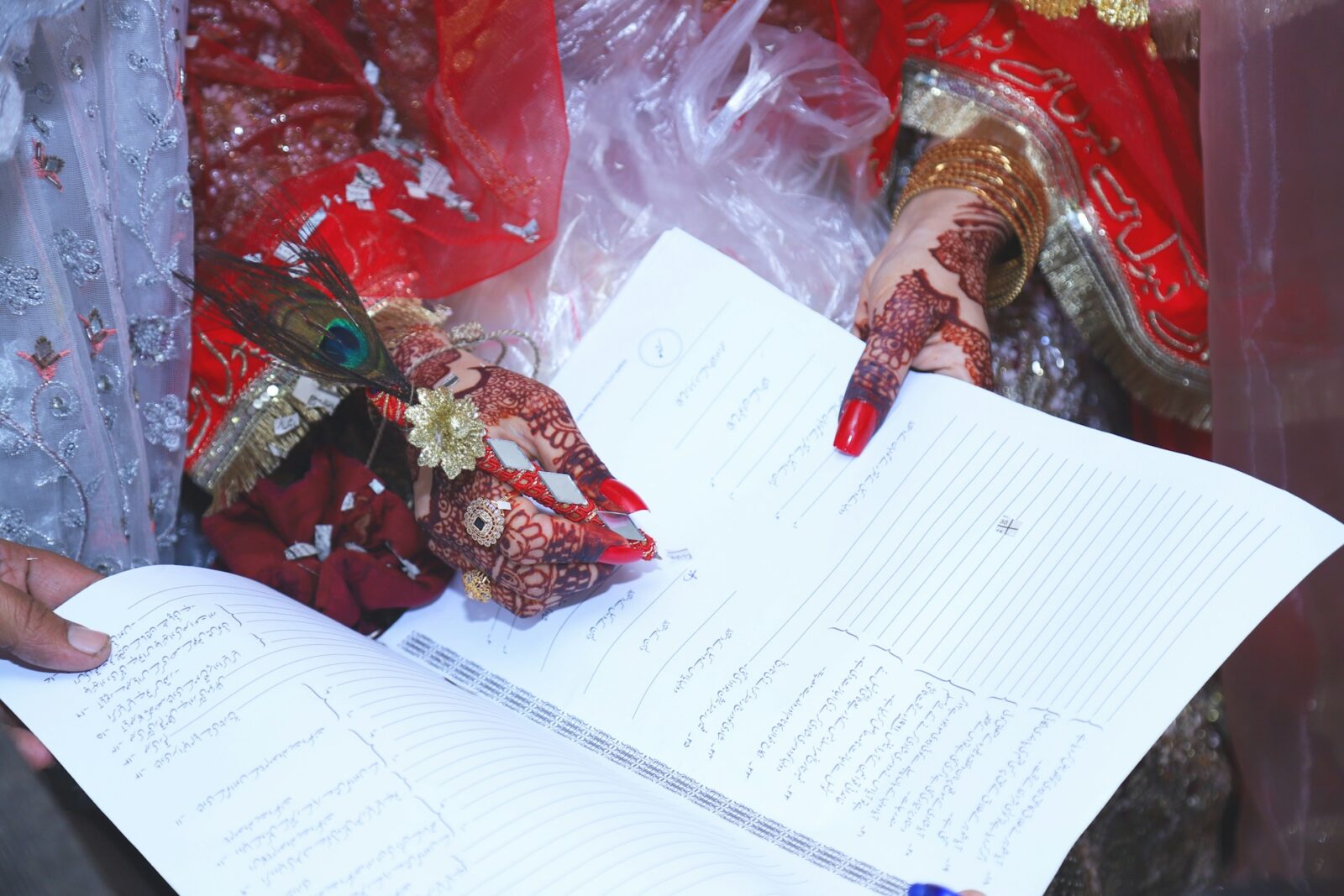

“You ought to have known the law had changed.” On 19 January 2026, those words concluded the “legal first” Northampton child marriage prosecution case. The imam (religious cleric) before the court solemnised an Islamic marriage (nikah) for two 16-year-olds, contrary to s121 3(A) of the Anti-social Behaviour, Crime and Policing Act 2014 (the Act). The case has been anointed as “the legal first,” depicting the narrow reach of law to underage marriages, even if coercion or use of force remains absent. While the sentencing remarks (the remarks) emphasising “child protection” remain crucial, this case prompts a more difficult legal question: does the law permit underage marriages by allowing a loophole for a religious marriage to be solemnised before the civil requirements are abided by, notably, which includes capacity and verification of age?
What is striking about this case is that it does not fit the familiar image of forced marriage as overt compulsion. That said, it was an underage marriage and an offence. Simultaneously, the court’s remarks recognise that while there was no coercion, deception or force, it cannot undermine the social harms of child marriage. Justice Choudhry’s remarks reflect the legislative shift embodied in the 2023 reforms, whereby child marriage is treated as harmful in itself even in the absence of violence or pressure.
The harm was assessed at the lowest level as the children acted voluntarily, and there was no evidence of any immediate psychological or physical harm. While the imam’s negligence (being unaware of the changes in law) was factored in, the remarks failed to address a more troubling point. This negligence was not merely confined to the English law but also the formalities of Islamic marriage, a domain in which the imam is presumed to be the expert. A valid nikah requires witnesses from both sides, and the bride requires a guardian present; in the nikah solemnised by the imam, none were present. The solemnisation appears to have simply relied on the imam’s willingness to proceed with marrying 2 minors. In this respect, the remarks not only underexplored the imam’s negligence but also the procedural sequence that made it possible for the marriage to occur. The legal process for marriage in England and Wales requires compliance with certain formalities, including age verification. In contrast, a religious ceremony can still be solemnised outside or before the legally prescribed route. For some citizens, including the minors in this case; the requirements are merely administrative, and the religious ceremony takes precedence. While the law itself might not recognise such a marital union, that does not render the harm unreal. This is precisely why a mandatory legal requirement penalising any religious ceremony solemnised before civil registration should be understood not as a bureaucratic palaver, but rather as a safeguarding measure.
Plainly, the structure of the legal intervention remains reactive rather than preventive. The legal framework continues to rely on the retrospective criminal sanction, intervening only after the minors were married 2.5 years ago. Despite placing substantial weight on child protection, the framework remains incapable of preventing underage religious marriage before it occurs.
Justice Choudary’s insistence that religion cannot “override compliance with the law” is crucial. Properly understood, this does not suppress religious marriage; it reinforces the subordination of religious procedure to law and civil legality. This is not an argument against religion or that Islamic marriages are problematic. Both Islamic nikah practice and English Law place weight on consent, formal responsibility in marriage and witnesses. This case is not intended to suppress religious marriage or depict a nikah or any religious marriage as a competing procedure against the state. Rather, to reorder the sequence in which authority operates. For the law’s ambition to be reflected in procedure, civil registration must be provided as the mandatory requirement for any religious solemnisation in England and Wales. The Pheras, a Chatunah or a Nikah, may follow; any religious rite may follow. Simply, ritual should be the successor to the register, not the other way round. Only then, safeguarding ceases to be a matter of belated prosecution and becomes one of legal design. What the Northampton case reveals is that the law does not require sharper penalties; it needs a different order.
Much of the commentary focuses on the case being a legal first and the suspended sentence. It is submitted that the real significance lies elsewhere, for the ruling exposes the inadequacy of a framework which recognises harm in principle but continues to rely on “marriage certificates” being found. This legal first is to signify that, beyond its title, its implications must be assessed. It reveals the structural flaw that the problem is not the absence of penalties, but the absence of order. It is crucial to assess the ease with which the prohibition was circumvented. Practically, all it took to breach the law was £50, 2 children and a negligent imam.


0 Comments