
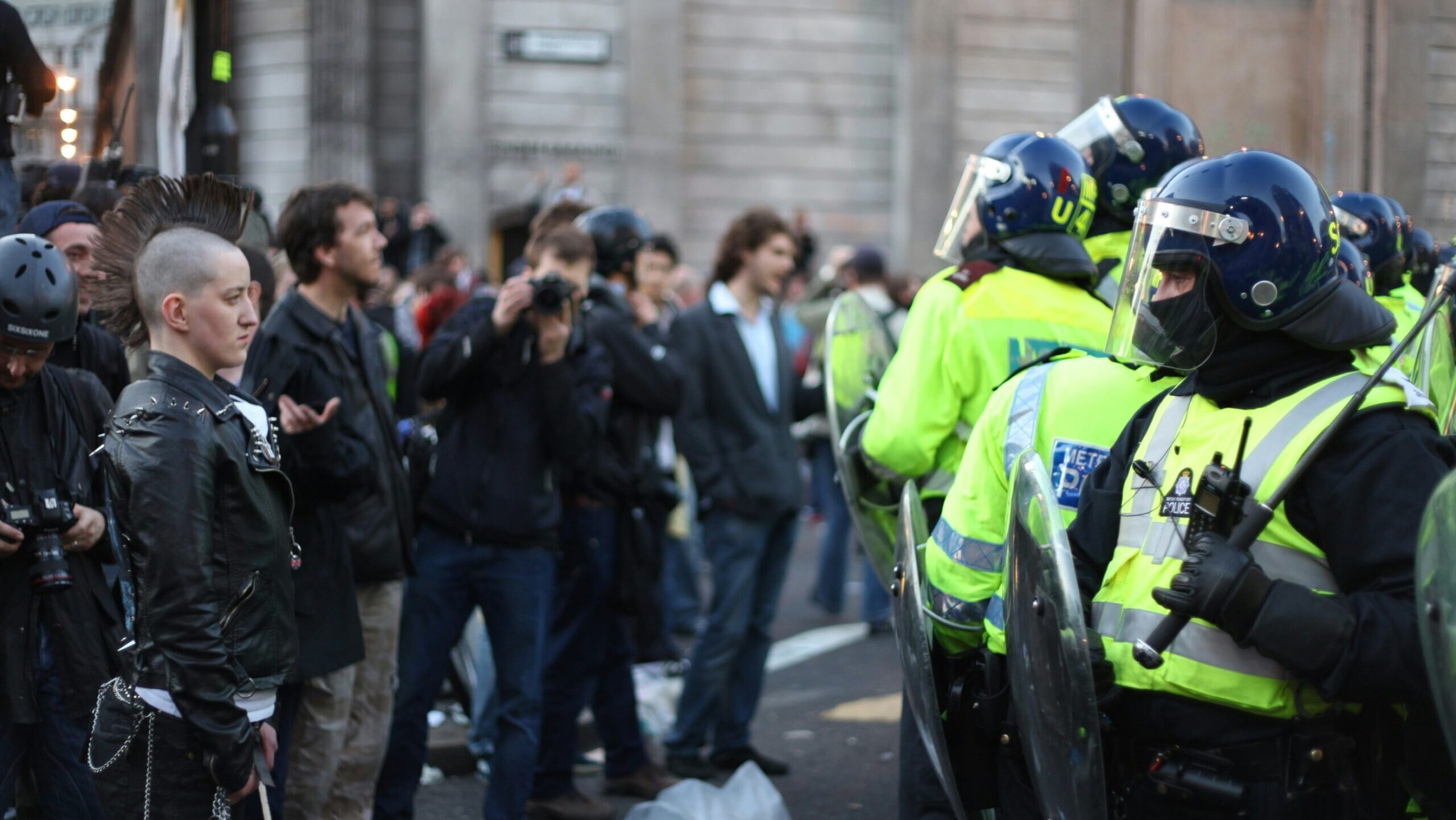

The recent Crime and Policing Act 2026 (the Act) introduces further restrictive measures affecting protest in the UK. This Act adds to a growing body of legislation governing an individual’s ability to peacefully protest, by creating new offences and expanding police powers, while building on measures introduced by the Police, Crime, Sentencing and Courts Act 2022, the Public Order Act 1986, and the Public Order Act 2023. Within the context of Articles 10 and 11 of the European Convention on Human Rights (ECHR), such measures call into question the pattern of an increasingly restrictive approach to protest rights in the UK.
The Crime and Policing Act 2026
The Act introduces new offences, including constraints on wearing face coverings in designated ‘mask-free zones’ at protests (ss 157, 158, and 159) and offences relating to climbing on certain memorials and monuments (s 161, Schedule 17). The Act also creates offences concerning protests outside or in the vicinity of the private residence of a public office-holder (s 162).
The Act widens the circumstances in which the police may restrict protests under the Public Order Act 1986 by introducing “relevant cumulative disruption” as a consideration (s 165) and whether the protest would create an intimidating atmosphere around places of worship (s 164). Such provisions raise concerns over the availability of such wide-reaching discretionary measures to control protest.
In particular, the consideration of “cumulative disruption” raises interesting ideological questions surrounding the nature of protest. The new legislation defines “relevant cumulative disruption” as encompassing disruption to “the life of the community” resulting from the procession in question and any other procession or public assembly that is held, or intended to be held, in the same area. Critically, this applies regardless of whether or not the protests are organised by the same person, attended by any of the same people, or are held or intended to be held at the same time. The concept of restricting protests based on “cumulative disruption” overlooks one of the fundamental facets of successful protest movements, which by design often require cumulative or repeated action to achieve results. Sustained protest has historically been an effective means of catalysing government action, and a measure that constrains this aspect arguably undermines what lies at the very core of successful protests.
The Right to Protest
Protesting is an effective tool for people to hold those in power accountable, and restrictions on it demand scrutiny as to their compatibility with Articles 10 and 11. These Articles provide important protections through the rights of freedom of expression and peaceful assembly, respectively. They are fundamental rights in a democratic society, but are not absolute, meaning they can be subject to restrictions in accordance with certain conditions. For instance, an interference with the right to freedom of peaceful assembly will constitute a breach of Article 11 unless it is “prescribed by law”, pursues a legitimate aim under Article 11(2), and is “necessary in a democratic society” to achieve those aims. The latter question revolves around proportionality.
Whilst some measures in the Act may be justifiable, such as restrictions on face-coverings by reference to general public safety or crime prevention aims, other measures introduced merit further scrutiny in this regard.
A Pattern of Restriction
The Act must not be considered in isolation. It fits within a broader wave of UK legislation governing protest. The Police, Crime, Sentencing and Courts Act 2022 and the Public Order Act 2023 introduced significant additional measures and expanded police powers in relation to protest governance. For example, sections 73 to 74 of the former amended sections 12 to 14 of the Public Order Act 1986, widening the circumstances in which police may impose conditions on public processions and assemblies. Conditions may now be imposed on the basis of noise, where an “reasonably believes” it may result in “serious disruption to the activities of an organisation in the vicinity”. The Public Order Act 2023 went further, introducing protest-specific offences such as ‘locking-on’ (s 1). This criminalises a protest tactic of attaching oneself to another person, object, or land, where this causes, or is capable of causing, serious disruption. The 2023 Act also expands police powers to include powers to stop and search without suspicion in specified areas (s 11). The Crime and Policing Act 2026 has continued this trajectory of introducing further restrictions on protest.
Recent events have caught national and international attention, further illustrating the difficulties surrounding the right to protest. For example, the proscription of Palestine Action as a terrorist organisation in July 2025 gave rise to a legal challenge, with the Court of Appeal overturning the High Court’s decision and concluding that the proscription was lawful and proportionate. The widespread arrest (see Secretary of State for the Home Department v R (Ammori), [148]) of individuals in connection with the initial decision around proscription demonstrates the real-life consequences that legal classifications have for the exercise of protest rights by individuals. Such headlines have spurred fresh discussions about the extent to which protest activity may be curtailed by the State.
Overall, these developments raise questions about the direction of UK government policy in this area and the dangers of the aggregate effects of such restrictions. Taken in isolation, the Crime and Policing Act 2026 may be capable of justification in relation to qualifying fundamental rights. However, when situated alongside the expanding body of criminal offences, police powers, and other restrictions, the Act contributes to a worrying landscape of increasing encroachment upon the fundamental democratic right to protest.


0 Comments